Home / Hornet Nest Removal
KW Pest Control removes bald-faced hornet and European hornet nests from homes, yards and businesses in Kitchener, Waterloo, Cambridge and Guelph. We treat nests in trees, hedges, eaves, sheds and walls and remove exposed nests once the colony is dead. Hornet nest removal starts at about $200 before HST. Call 519-957-1766 for a free phone estimate.
Call 519-957-1766 Get a Free Phone Estimate
Licensed and insured technicians · Free estimates over the phone · Health Canada-registered products · 100% satisfaction guarantee · Residential and commercial
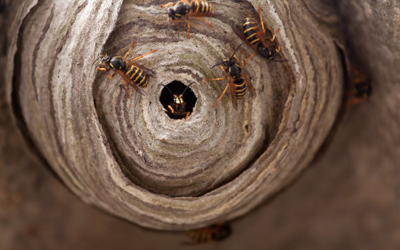
Two kinds of hornet are common in Waterloo Region and Guelph.
Bald-faced hornets are black with white markings on the face and the tip of the abdomen. They’re technically a kind of yellowjacket, but everyone calls them hornets. They build the large, grey, football- or teardrop-shaped paper nests you see hanging in trees, hedges, shrubs and under eaves. A mature nest can hold several hundred hornets by late summer.
European hornets are larger, brown and yellow, and are often mistaken for very big yellowjackets. They usually nest in hollow trees, wall voids, attics and sheds, and unlike most wasps they fly at night and are drawn to porch lights and lit windows.
You may have heard about the northern giant hornet, sometimes called the “murder hornet”. It has only been reported on the West Coast, in British Columbia and Washington State, and it isn’t the hornet you have in your Kitchener backyard.
Bald-faced hornets defend their nest aggressively. Bumping a hedge, mowing under a tree or shaking a branch can bring dozens of them out at once, and each one can sting more than once. Nests are often hidden in thick foliage until you’re right on top of them, and many are high enough to need a ladder, which is the worst place to be when hornets come out.
Store-bought sprays don’t reach the centre of a large paper nest, where the queen and young are. Knocking a nest down with a stick or hose just releases an angry colony. For anyone with a sting allergy, any hornet nest near the house is a job for a professional.
| Bald-faced hornet | Yellowjacket wasp | |
|---|---|---|
| Colour | Black and white | Yellow and black |
| Typical nest | Large exposed grey paper nest in trees, hedges or eaves | Hidden in walls, soffits or the ground |
| Nest size by August | Football-sized or larger | Mostly hidden; can be very large inside walls |
| Removal | Treat, then remove the exposed nest | Treat at the entrance; nest stays inside |
For yellowjackets, paper wasps and mud daubers, see wasp and bee nest removal.
You may see a few hornets around the spot for a day or two. These are workers that were away when the nest was treated.
Typical prices before HST:
Your technician confirms the price before starting. See the pest control cost guide.
Queens come out of hibernation in spring and start nests in May. Nests grow quickly through June and July, and hornets are most numerous and most defensive from August into September. The colony dies off after the first hard frost. Old nests aren’t reused, but new queens may build nearby next year, so it’s worth checking trees and eaves each spring.
KW Pest Control serves homes and businesses in four cities: Kitchener, Waterloo, Cambridge and Guelph. That includes downtown Kitchener and Doon, Uptown Waterloo and Beechwood, Galt, Preston and Hespeler in Cambridge, and every Guelph neighbourhood from the Ward to the south end. Not sure we cover your street? Call 519-957-1766 and ask.
Kitchener · Waterloo · Cambridge · Guelph
Hornet nest removal starts at about $200 before HST for an exposed nest in a tree, hedge or under the eaves. Nests inside walls, soffits or attics start at about $250. Each additional nest at the same visit is about $50 to $75. Your technician confirms the price before starting.
If a nest is high in a tree at the back of a large yard, away from doors, play areas and paths, leaving it until frost is often fine, because hornets also eat other insects. If it’s near a door, deck, hedge you trim, window or anyone with a sting allergy, it should be treated.
No. Hornet colonies die off in late fall, and only new queens survive the winter, hiding under bark, in woodpiles or in sheltered spots. Queens don’t reuse old nests. They may build a new nest nearby the following spring, so check trees, hedges and eaves in May and June.
Yes. Most bald-faced hornet nests we remove are in trees, hedges and shrubs. We treat the nest first so the colony dies, then take it down and bag it where it’s reachable. Nests very high in large trees may be treated and left in place to dry out.
European hornets are large and their sting is painful, but they’re usually less defensive than bald-faced hornets unless the nest is disturbed. They nest in hollow trees, walls and attics and are active at night, so they often show up at lit windows. A nest inside the house should be treated by a professional.
Call 519-957-1766 and tell us what you’re seeing. Estimates over the phone are free, and an inspection is required for an exact quote on larger jobs. The office is open Monday to Friday, 8:30 a.m. to 5 p.m.; leave a message after hours and we’ll call you back the next business day.
KW Pest Control provides residential and commercial pest control in Kitchener, Waterloo, Cambridge and Guelph, for mice and rats, wasps and hornets, ants, bed bugs, cockroaches, spiders, fleas, flies, centipedes and moths. Call 519-957-1766 for a free phone estimate, or use our contact form and we’ll get back to you during office hours.
Hours: Monday to Friday, 8:30 a.m. to 5 p.m.
Leave a message and we’ll call you back the next business day.
Copyright © 2026 KW Pest Control. All Rights Reserved.